Your Medical Advices: October 2014

Tuesday, October 7, 2014

Cardiovascular Examination

REVIEW OF SPECIFIC SYMPTOMS


The important symptoms of cardiac disease are the following:

  • Chest pain
  • Palpitations
  • Dyspnea
  • Syncope
  • Fatigue
  • Dependent edema
  • Hemoptysis
  • Cyanosis

CHEST PAIN

Chest pain is probably the most important symptom of cardiac disease. It is not, however, pathognomonic for heart disease. It is well known that chest pain may result from pulmonary, intestinal, gallbladder, and musculoskeletal disorders. Ask the following questions of any patients complaining of chest pain:
  • “Where is the pain?”
  • “How long have you had the pain?”
  • “Do you have recurrent episodes of pain?”
  • “What is the duration of the pain?”
  • “How often do you get the pain?”
  • “What do you do to make it better?”
  • “What makes the pain worse? Breathing? Lying flat? Moving your arms or neck?”
  • “How would you describe the pain?1 Burning? Pressing? Crushing? Dull? Aching? Throbbing? Knifelike? Sharp? Constricting? Sticking?”
  • “Does the pain occur at rest? With exertion? After eating? When moving your arms? With emotional 
  • strain? While sleeping? During sexual intercourse?”
  • “Is the pain associated with shortness of breath? Palpitations? Nausea or vomiting? Coughing? 
  • Fever? Coughing up blood? Leg pain?”


PALPITATIONS

Palpitations are the uncomfortable sensations in the chest associated with a range of arrhythmias. Patients may describe palpitations as “fluttering,” “skipped beats,” “pounding,” “jumping,” “stopping,” or “irregularity.” Determine whether the patient has had similar episodes and what was done to extinguish them. Palpitations are common and do not necessarily indicate serious heart disease. Any condition in which there is an increased stroke volume, as in aortic regurgitation, may be associated with a sensation of “forceful contraction.” When a patient complains of palpitations, ask the following questions:
  • “How long have you had palpitations?”
  • “Do you have recurrent attacks?” If so, “How frequently do they occur?”
  • “When did the current attack begin?”
  • “How long did it last?”
  • “What did it feel like?”
  • “Did any maneuvers or positions stop it?”
  • “Did it stop abruptly?”
  • “Could you count your pulse during the attack?”
  • “Can you tap out on the table what the rhythm was like?”
  • “Have you noticed palpitations after strenuous exercise? On exertion? While lying on your left side? After a meal? When tired?”
  • “During the palpitations, have you ever fainted? Had chest pain?”
  • “Was there an associated flush, headache, or sweating associated with the palpitations?”2
  • “Have you noticed an intolerance to heat? Cold?”
  • “What kind of medications are you taking?”
  • “Do you take any medications for your lungs?”
  • “Are you taking any thyroid medications?”
  • “Have you ever been told that you had a problem with your thyroid?”
  • “How much tea, coffee, chocolate, or cola sodas do you consume a day?”
  • “Do you smoke?” If yes, “What do you smoke?”
  • “Do you drink alcoholic beverages?”
  • “Did you notice that after the palpitations you had to urinate?”
DYSPNEA

  • The complaint of dyspnea is important. Patients report that they have “shortness of breath” or that they “can’t get enough air.” Dyspnea is commonly related to cardiac or pulmonary condition.
  • Paroxysmal nocturnal dyspnea (PND) occurs at night or when the patient is supine. This position increases the intrathoracic blood volume, and a weakened heart may be unable to handle this increased load; congestive heart failure may result. The patient is awakened about 2 hours after having fallen asleep, is markedly dyspneic, is often coughing, and may seek relief by running to a window to “get more air.” Episodes of PND are relatively specific for congestive heart failure.
  • The symptom of PND is often associated with the symptom of orthopnea, the need for using more pillows on which to sleep. Inquire of all patients, “How many pillows do you need to sleep?” To help quantify the orthopnea, you can state, for example, “Three-pillow orthopnea for the past 4 months.”
  • Dyspnea on exertion (DOE) is usually caused by chronic congestive heart failure or severe pulmonary disease.
  • Trepopnea is a rare form of positional dyspnea in which the dyspneic patient has less dyspnea while lying on the left or right side. The pathophysiologic process of trepopnea is not well understood.
SYNCOPE

Fainting, or syncope, is the transient loss of consciousness that results from inadequate cerebral perfusion. Ask patients what they mean by “fainting” or “dizziness.” Syncope may have cardiac or noncardiac causes. When a patient describes fainting, ask the following questions:
  • “What were you doing just before you fainted?”
  • “Have you had recurrent fainting spells?” If so, “How often do you have these attacks?”
  • “Was the fainting sudden?”
  • “Did you lose consciousness?”
  • “In what position were you when you fainted?”
  • “Was the fainting preceded by any other symptom? Nausea? Chest pain? Palpitations? Confusion? Numbness? Hunger?”
  • “Did you have any warning that you were going to faint?”
  • “Did you have any black, tarry bowel movements after the faint?”
The activity that preceded the syncope is important because some cardiac causes are associated with syncope during exercise (e.g., valvular aortic stenosis, idiopathic hypertrophic subaortic stenosis, and primary pulmonary hypertension). If a patient describes palpitations before the syncope, an arrhythmogenic cause may be present. Cardiac output may be reduced by arrhythmias or obstructive lesions.

Orthostatic hypotension is a common form of postural syncope and is the result of a peripheral autonomic limitation. There is a sudden fall in systemic blood pressure, resulting from a failure of adaptive reflexes to compensate for an erect posture. Symptoms of orthostatic hypotension include dizziness, blurring of vision, profound weakness, and syncope. Many drugs can cause orthostatic hypotension by leading to changes in intravascular volume or tone. Older patients are most prone to orthostatic hypotension.

Micturition syncope usually occurs in men during straining with nocturnal urination. It may occur after considerable alcohol consumption.

Vasovagal syncope is the most common type of fainting and is one of the most difficult to manage. It has been estimated that 40% of all syncopal events are vasovagal in nature. Vasovagal syncope occurs during periods of sudden, stressful, or painful experiences, such as receiving bad news, surgical manipulation, trauma, the loss of blood, or even the sight of blood. It is often preceded by pallor, nausea, weakness, blurred vision, lightheadedness, perspiring, yawning, diaphoresis, hyperventilation, epigastric discomfort, or a “sinking feeling.” There is a sudden fall in systemic vascular resistance without a compensatory increase in cardiac output as a result of an increased vagotonia. If the patient sits or lies down promptly, frank syncope
can be aborted.

Carotid sinus syncope is associated with a hypersensitive carotid sinus and is most common in the older adult population. Whenever a patient with carotid sinus syncope wears a tight shirt collar or turns the neck in a certain way, there is an increased stimulation of the carotid sinus. This causes a sudden fall in systemic pressure, and syncope results. Two types of carotid sinus hypersensitivity exist: a cardioinhibitory (bradycardia) type and a vasodepressor (hypotension without bradycardia) type.

Posttussive syncope usually occurs in patients with chronic obstructive lung disease. Several mechanisms have been postulated to explain its occurrence. It is generally accepted that coughing produces an increase in intrathoracic pressure, which decreases both venous return and cardiac output. There may also be a rise in cerebrospinal fluid pressure, producing a decreased perfusion to the brain.

FATIGUE

Fatigue is a common symptom of decreased cardiac output. Patients with congestive heart failure and mitral valvular disease frequently complain of fatigue. Fatigue, however, is not specific for cardiac problems. The most common causes of fatigue are anxiety and depression. Other conditions associated with fatigue include anemia and chronic diseases. You must attempt to differentiate organic from psychogenic fatigue. Ask the following questions: 
  • “How long have you been tired?”
  • “Did the fatigue start suddenly?”
  • “Do you feel tired all day? In the morning? In the evening?”
  • “When do you feel least tired?”
  • “Do you feel more tired at home than at work?”
  • “Is the fatigue relieved by rest?”
Patients with psychogenic fatigue are tired “all the time.” They are often more tired at home than at work but occasionally describe being more tired in the morning. They may feel their best at the end of the day, which is when most patients with organic causes feel the worst.

DEPENDENT EDEMA

Swelling of the legs, a form of dependent edema, is a frequent complaint of patients. Ask the following questions: 


Monday, October 6, 2014

Circuitry of Cardiovascular System

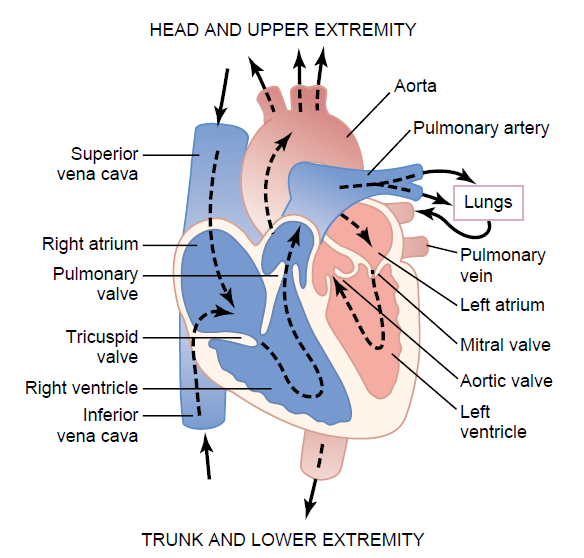
The steps in one complete circuit through the cardiovascular system are shown in figure. The cycled numbers in the figure correspond with the steps described here: 
A schematic diagram showing the circuitry of the cardiovascular system
  1. Oxygenated blood fills the left ventricle.  Blood that has been oxygenated in the lungs returns to the left atrium via the pulmonary vein. This blood then flows from the left atrium to the left ventricle through the mitral valve (the AV valve of the left heart).
  2. Blood is ejected from the left ventricle into the aorta.  Blood leaves the left ventricle through the aortic valve (the semilunar valve of the left side of the heart), which is located between the left ventricle and the aorta. When the left ventricle contracts, the pressure in the ventricle increases, causing the aortic valve to open and blood to be ejected forcefully into the aorta. (As noted previously, the amount of blood ejected from the left ventricle per unit time is called the cardiac output.) Blood then flows through the arterial system, driven by the pressure created by contraction of the left ventricle.
  3. Cardiac output is distributed among various organs.  The total cardiac output of the left heart is distributed among the organ systems via sets of parallel arteries. Thus, simultaneously, 15% of the cardiac output is delivered to the brain via the cerebral arteries, 5% is delivered to the heart via the coronary arteries, 25% is delivered to the kidneys via the renal arteries, and so forth. Given this parallel arrangement of the organ systems, it follows that the total systemic blood flow must equal the cardiac output.
  4. Blood flow from the organs is collected in the veins.  The blood leaving the organs is venous blood and contains waste products from metabolism, such as carbon dioxide (CO2). This mixed venous blood is collected in veins of increasing size and finally in the largest vein, the vena cava. The vena cava carries blood to the right heart.
  5. Venous return to the right atrium.  Because the pressure in the vena cava is higher than in the right atrium, the right atrium fills with blood, the venous return. In the steady state, venous return to the right atrium equals cardiac output from the left ventricle. 
  6. Mixed venous blood fills the right ventricle.  Mixed venous blood flows from the right atrium to the right ventricle through the AV valve in the right heart, the tricuspid valve.
  7. Blood is ejected from the right ventricle into the pulmonary artery.  When the right ventricle contracts, blood is ejected through the pulmonic valve (the semilunar valve of the right side of the heart) into the pulmonary artery, which carries blood to the lungs. Note that the cardiac output ejected from the right ventricle is identical to the cardiac output that was ejected from the left ventricle. In the capillary beds of the lungs, oxygen (O2) is added to the blood from alveolar gas, and CO2 is removed from the blood and added to the alveolar gas. Thus, the blood leaving the lungs has more O2 and less CO2 than the blood that entered the lungs.
  8. Blood flow from the lungs is returned to the heart via the pulmonary vein.  Oxygenated blood is returned to the left atrium via the pulmonary vein to begin a new cycle.
Structure of the heart, and course of blood flow through the heart
chambers and heart valves.


    Gynecologic History

    General
    • Name, age and occupation
    • A brief statement of the general nature and duration of the main complaints (try to use the patient’s own words rather than medical terms at this stage)

    History of presenting complaint
    • This section should focus on the presenting complaint, e.g. menstrual problems, pain, subfertility, urinary incontinence, etc. The detailed questions relating to each complaint are covered in more detail in the relevant chapters, but there are certain important aspects of a gynaecological history that should always be enquired about.
    Menstrual history
    • Age of menarche
    • Usual duration of each period and length of cycle (usually written as mean number of days of bleeding over usual length of full cycle, e.g. 5/28)
    • First day of the last period
    • Pattern of bleeding: regular or irregular and length of cycle
    • Amount of blood loss: more or less than usual, number of sanitary towels or tampons used, passage of clots or flooding
    • Any intermenstrual or post-coital bleeding
    • Any pain relating to the period, its severity and timing of onset
    • Any medication taken during the period (including over-the-counter preparations).
    Previous gynaecological history
    • This section should include any previous gynaecological treatments or surgery.
    Previous obstetric history
    • Number of children with ages and birth weights.
    • Any abnormalities with pregnancy, labour or the puerperium
    • Number of miscarriages and gestation at which they occurred
    • Any terminations of pregnancy with record of gestational age and any complications.
    Previous medical history
    • Any serious illnesses or operations with dates
    • Family history.
    Enquiry about other systems
    • Appetite, weight loss, weight gain
    • Bowel function (if urogynaecological complaint, more detail may be required)
    • Bladder function (if urogynaecological complaint, more detail may be required).
    • Enquiry of other systems
    Social history
    • Sensitive enquiry should be made about the woman’s social situation including details of her occupation, who she lives with, her housing and whether or not she’s in a stable relationship.
    • A history regarding smoking and alcohol intake should also be obtained. Any pertinent family or other relevant social problems should be briefly discussed. If admission and surgery are being contemplated it’s necessary to establish what support she has at home, particularly if she is elderly or frail.

    Heart

    Cardiac orientation

    The general shape and orientation of the heart are that of a pyramid that has fallen over and is resting on one of its sides . Placed in the thoracic cavity, the apex of this pyramid projects forward, downward, and to the left, whereas the base is opposite the apex and faces in a posterior direction (Fig. 1) . The sides of the pyramid consist of:
    • diaphragmatic (inferior) surface on which the pyramid rests,
    • an anterior (sternocostal) surface oriented anteriorly,
    • a right pulmonary surface, and
    • a left pulmonary surface.
    Fig. 1 Base of the Heart

    Because the great veins enter the base of the heart, with the pulmonary veins entering the right and left sides of the left atrium and the superior and inferior venae cavae at the upper and lower ends of the right atrium, the base of the heart is fixed posteriorly to the pericardia! wall, opposite the bodies of vertebrae TV to TVIII (TVI to TIX when standing) . The esophagus lies immediately posterior to the base.

    From the base the heart proj ects forward, downward, and to the left, ending in the apex. The apex of the heart is formed by the inferolateral part of the left ventricle (Fig. 2) and is positioned deep to the left fifth intercostal space, 8-9 em from the midsternal line.
    Fig. 2 Anterior Surface of the Heart

    Surfaces of the heart

    The anterior surface faces anteriorly and consists mostly of the right ventricle, with some of the right
    atrium on the right and some of the left ventricle on the left (Fig. 2 ).

    The heart in the anatomical position rests o n the diaphragmatic surface, which consists of the left ventricle
    and a small portion of the right ventricle separated by the posterior interventricular groove (Fig. 3) . This surface faces inferiorly, rests on the diaphragm, is separated from the base of the heart by the coronary sinus, and extends from the base to the apex of the heart.

    The left pulmonary surface faces the left lung, is broad and convex, and consists of the left ventricle and a
    portion of the left atrium (Fig. 3).

    The right pulmonary surface faces the right lung, is broad and convex, and consists of the right atrium
    (Fig. 3).
    Figs. 3 Diaphragmatic surface of the Heart 

    Margins and Borders

    Some general descriptions of cardiac orientation refer to right, left, inferior (acute), and obtuse margins:
    • The right and left margins are the same as the right and left pulmonary surfaces of the heart.
    • The inferior margin is defined as the sharp edge between the anterior and diaphragmatic surfaces of the heart (Figs. 2)-it is formed mostly by the right ventricle and a small portion of the left ventricle near the apex.
    • The obtuse margin separates the anterior and left pulmonary surfaces (Fig. 2)-it is round and extends from the left auricle to the cardiac apex (Fig. 2) , and is formed mostly by the left ventricle and superiorly by a small portion of the left auricle.
    External sulci

    Internal partitions divide the heart into four chambers (i.e. , two atria and two ventricles) and produce surface or external grooves referred to as sulci.
    • The coronary sulcus circles the heart, separating the atria from the ventricles {Fig. 4) . As it circles the heart, it contains the right coronary artery, the small cardiac vein, the coronary sinus, and the circumflex branch of the left coronary artery.
    • The anterior and posterior interventricular sulci separate the two ventricles-the anterior interventricular sulcus is on the anterior surface of the heart and contains the anterior interventricular artery and the great cardiac vein, and the posterior interventricular sulcus is on the diaphragmatic surface of the heart and contains the posterior interventricular artery and the middle cardiac vein.


    CARDIAC CHAMBERS

    The heart functionally consists of two pumps separated by a partition (Fig.1). The right pump receives deoxygenated blood from the body and sends it to the lungs. The left pump receives oxygenated blood from the lungs and sends it to the body. Each pump consists of an atrium and a ventricle separated by a valve.

    The thin-walled atria receive blood coming into the heart, whereas the relatively thick-walled ventricles pump
    blood out of the heart.
    More force is required to pump blood through the body than through the lungs, so the muscular wall of the left ventricle is thicker than the right.
    Fig. 1 The Heart has two pumps


    Right Atrium

    In the anatomical position, the right border o f the heart is formed by the right atrium. This chamber also contributes to the right portion of the heart's anterior surface.
    Blood returning to the right atrium enters through one of three vessels. These are:
    • the superior and inferior venae cavae, which together deliver blood to the heart from the body; and
    • the coronary sinus, which returns blood from the walls of the heart itself.
    The superior vena cava enters the upper posterior portion of the right atrium, and the inferior vena cava and
    coronary sinus enter the lower posterior portion of the right atrium.
    From the right atrium, blood passes into the right ventricle through the right atrioventricular orifice. This opening faces forward and medially and is closed during ventricular contraction by the tricuspid valve.

    The interior of the right atrium is divided into two continuous spaces. Externally, this separation is indicated by a shallow, vertical groove (the sulcus terminalis cordis) , which extends from the right side of the opening of the superior vena cava to the right side of the opening of the inferior vena cava. Internally, this division is indicated by the crista terminalis (Fig. 2) , which is a smooth, muscular ridge that begins on the roof of the atrium just in front of the opening of the superior vena cava and extends down the lateral wall to the anterior lip of the inferior vena cava.
    The space posterior to the crista is the sinus of venae cavae and is derived embryologically from the right horn of the sinus venosus. This component of the right atrium has smooth, thin walls, and both venae cavae empty into this space.

    The space anterior to the crista, including the right auricle, is sometimes referred to as the atrium proper.
    This terminology is based on its origin from the embryonic primitive atrium. Its walls are covered by ridges called the musculi pectinati (pectinate muscles), which fan out from the crista like the "teeth of a comb . " These ridges are also found in the right auricle, which is an ear-like, conical, muscular pouch that externally overlaps the ascending aorta.

    An additional structure in the right atrium is the opening of the coronary sinus, which receives blood
    from most of the cardiac veins and opens medially to the opening of the inferior vena cava. Associated with these openings are small folds of tissue derived from the valve of the embryonic sinus venosus (the valve of the coronary sinus and the valve of inferior vena cava, respectively) . During development, the valve of the inferior vena cava helps direct incoming oxygenated blood through the foramen ovale and into the left atrium.

    Separating the right atrium from the left atrium is the interatrial septum, which faces forward and to the right
    because the left atrium lies posteriorly and to the left of the right atrium. A depression is clearly visible in the septum just above the orifice of the inferior vena cava. This is the fossa ovalis (oval fossa) , with its prominent margin, the limbus fossa ovalis (border of the oval fossa).

    The fossa ovalis marks the location of the embryonic foramen ovale, which is an important part of fetal circulation. The foramen ovale allows oxygenated blood entering the right atrium through the inferior vena cava to pass directly to the left atrium and so bypass the lungs, which are nonfunctional before birth.

    Finally, numerous small openings-the openings of the smallest cardiac veins (the foramina of the venae
    cordis minimae)-are scattered along the walls of the right atrium. These are small veins that drain the myocardium directly into the right atrium.